
Last updated November 2, 2026
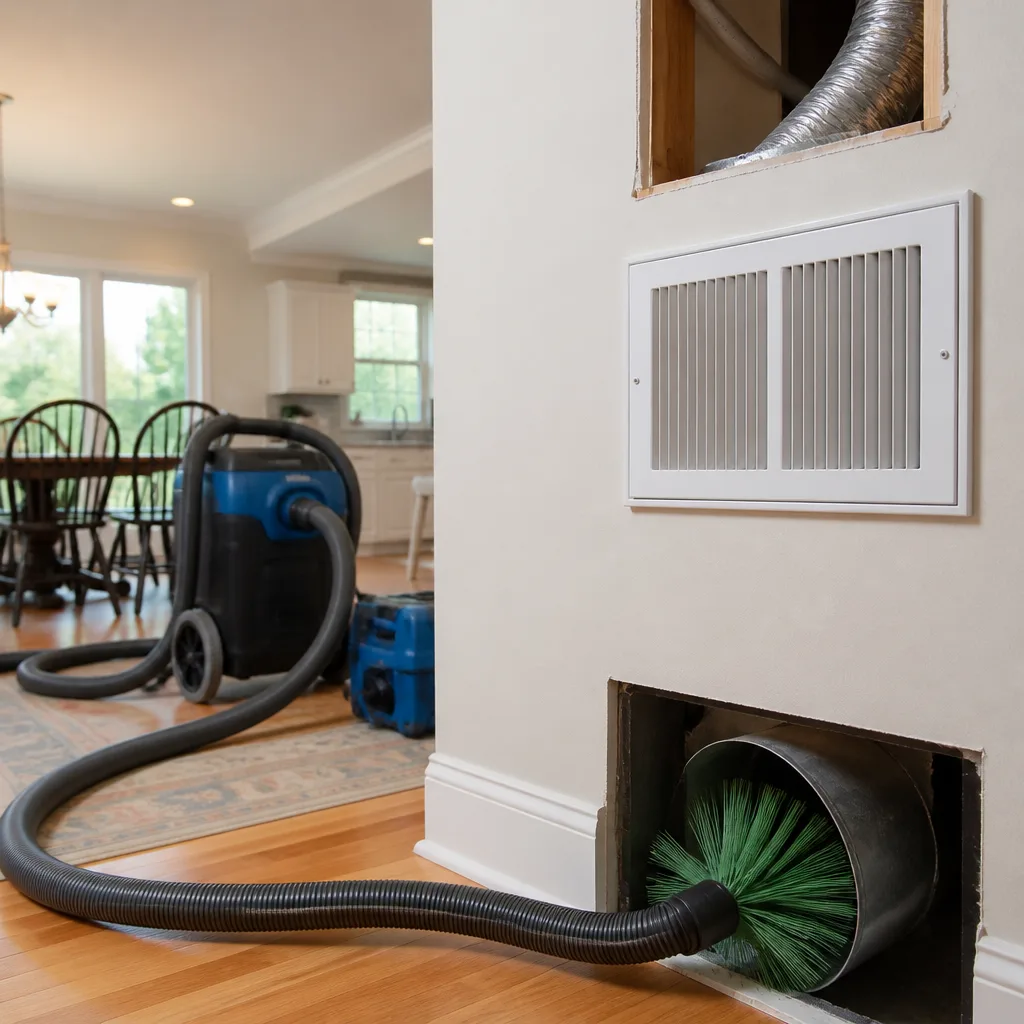 Whole-home duct cleaning
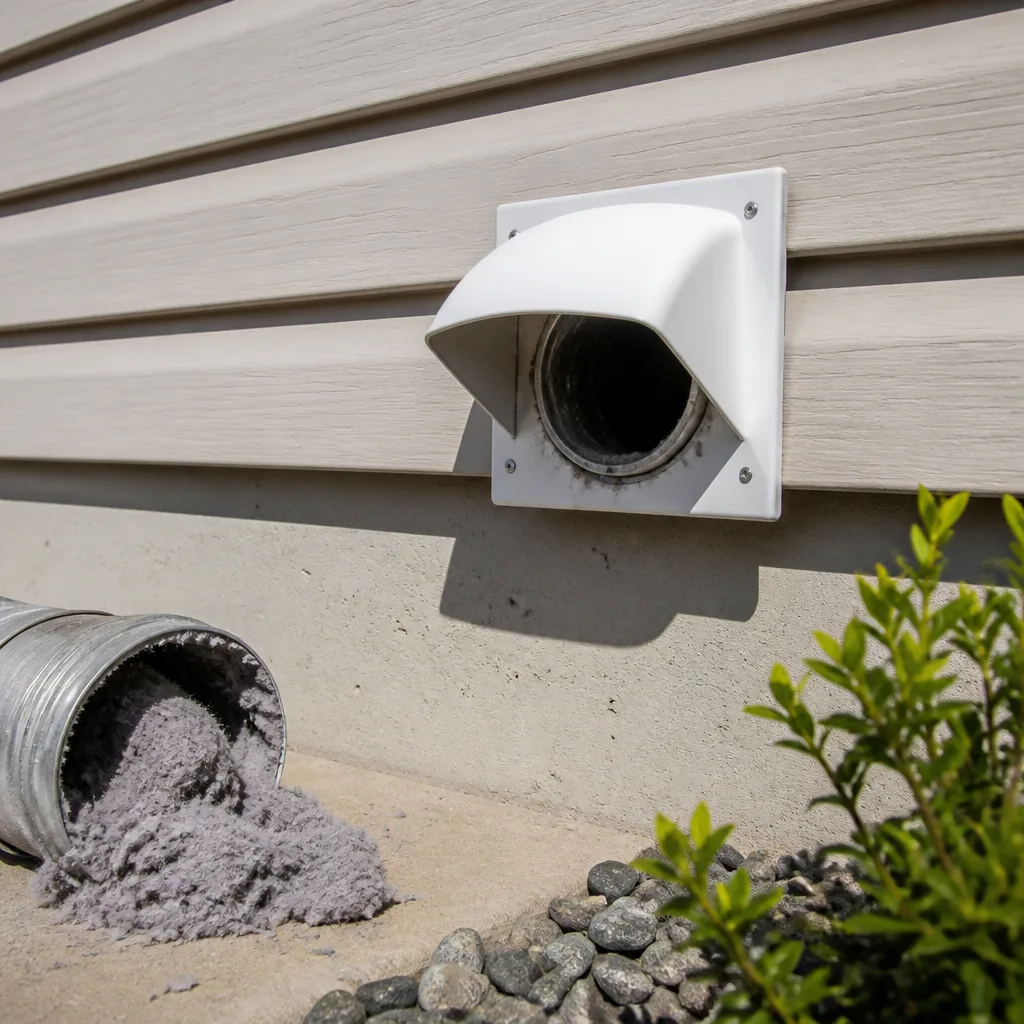 Dryer vent cleaning
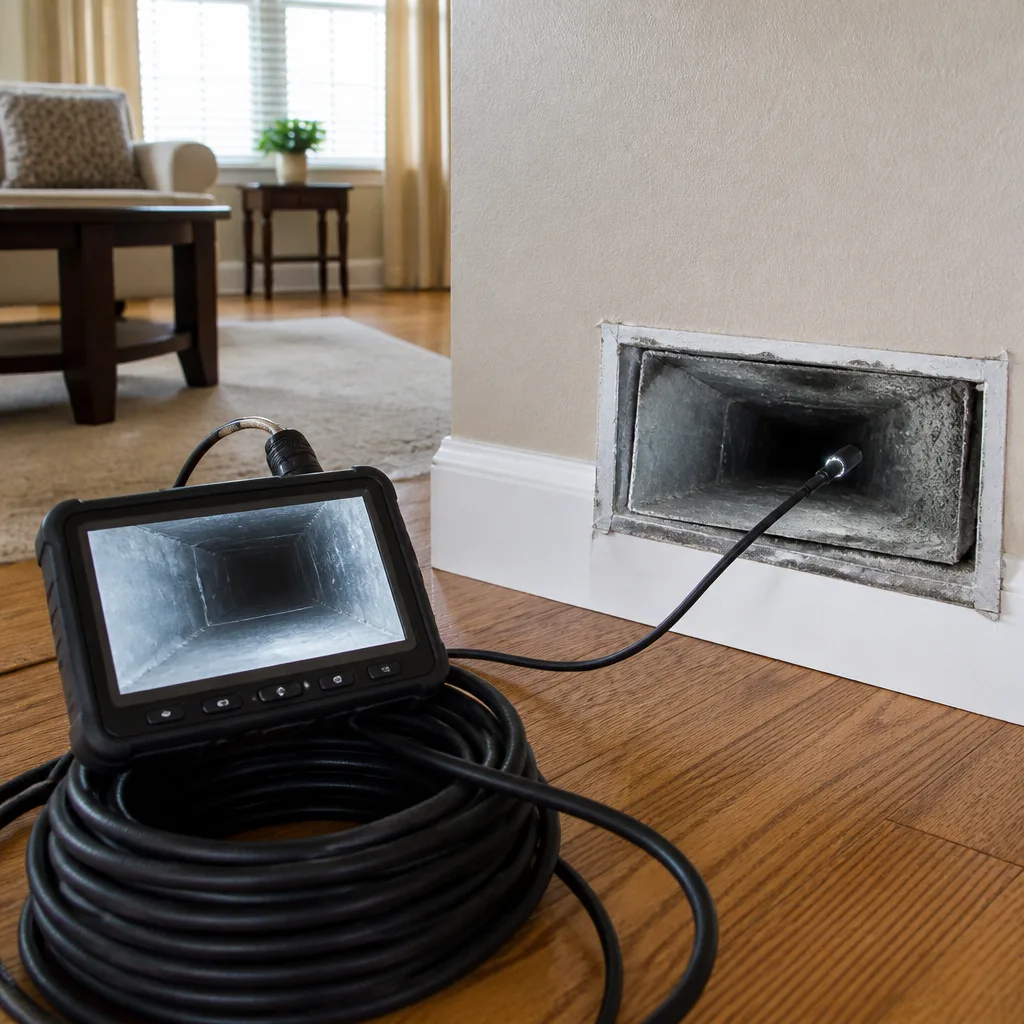 Camera inspection
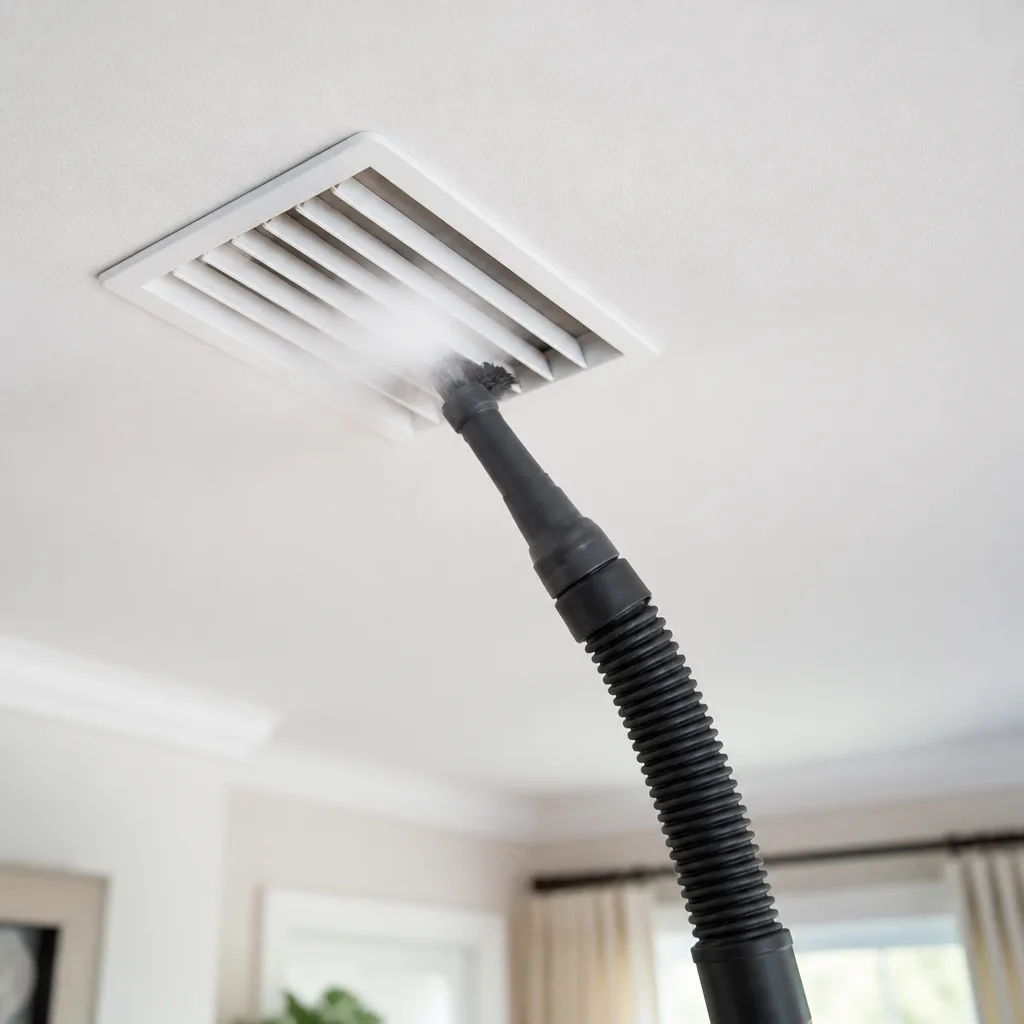 Sanitizing & deodorizing
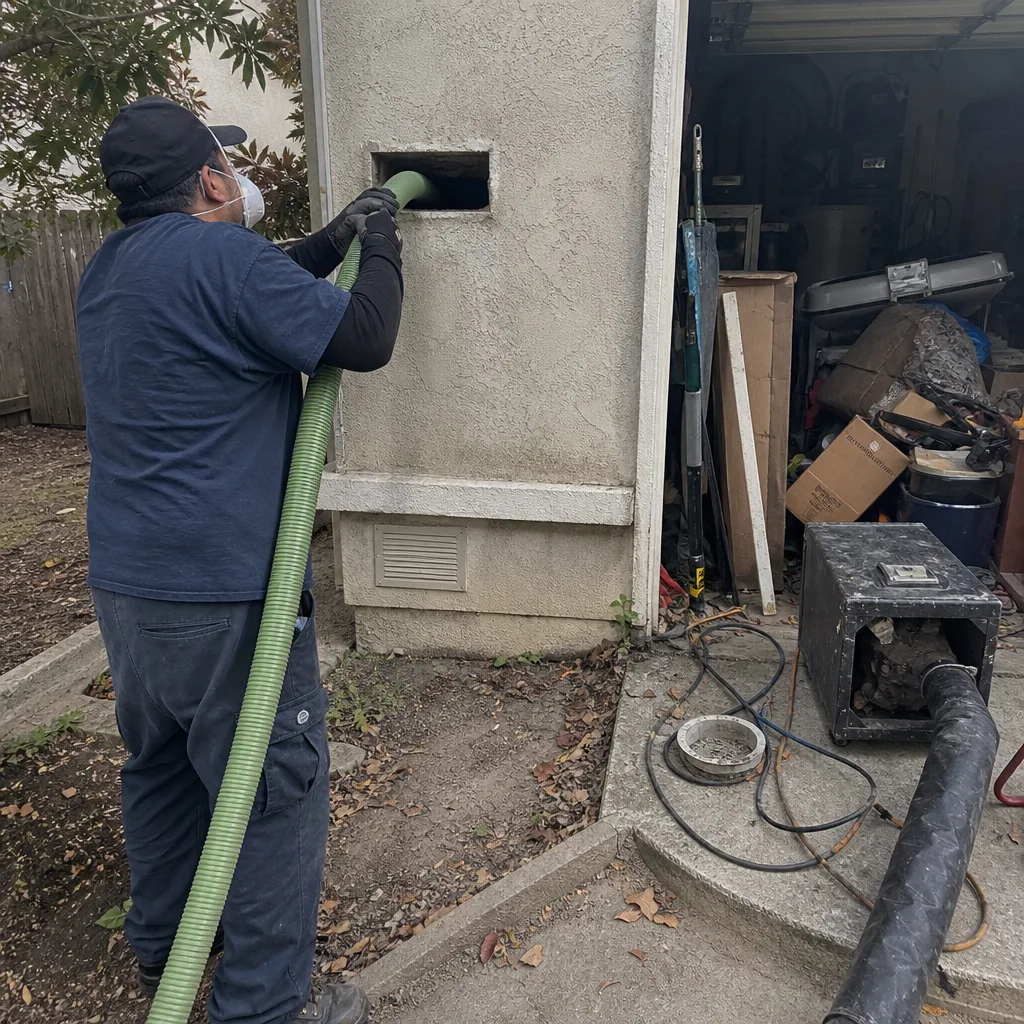
Whole-system duct and dryer vent check with before-and-after photos - you see exactly what came out of your vents
That "$99 whole-house special" is a bait ad - the real number appears once they are in your hallway, or the "clean" is a shop-vac at the register. We photograph the inside of your ducts before and after instead.
Seasonal Air Duct Cleaning Care for Oak Park: Year-Round Homeowner’s Guide
Most seasonal duct cleaning guides recycle the same tired advice: clean in spring, clean in fall, repeat. In Oak Park, that calendar-based thinking is backwards. Fall isn’t when you clean up from contamination here. Fall is when contamination happens. Between Santa Ana wind events pushing wildfire smoke and ash through our neighborhoods, and the first furnace startup blowing months of accumulated debris through the system, October through December is the single most punishing stretch for ductwork in Ventura County. This guide explains the real seasonal rhythm of Oak Park air ducts: when contamination occurs, when cleaning makes sense, and what you can do between professional services to keep the system functional. If you’ve lived here through even one fire season, you already know Oak Park air doesn’t behave like the rest of Southern California. Your ductwork knows it too.
Styles & brands we work with
- Whole-home duct cleaning
- Dryer vent cleaning
- Camera inspection
- Sanitizing & deodorizing
Quick Answer
The most effective seasonal duct cleaning schedule for Oak Park homes is driven by two stress peaks: a post-Santa Ana cleaning window in November or December after wildfire smoke and ash settle, and a pre-cooling-season inspection in April or May before the AC runs daily. Homes within a mile of open brush or with occupants who have allergies or asthma often benefit from a second professional cleaning in late summer after irrigation-related humidity exposes any microbial growth in the duct lining. The lowest-value cleaning times are mid-winter and mid-summer, when the system runs steadily and contamination inputs are lowest.
Table of Contents
- Oak Park’s Seasonal Reality: Why Calendar Advice Fails Here
- Fall and Santa Ana Season: The Contamination Window
- Winter: The Post-Event Cleaning Window (November – December)
- Spring HVAC Startup: What to Inspect Before First AC Use
- Summer: Irrigation Humidity and the Microbial Question
- Low-Season Maintenance: What You Can Do Yourself
- Wildfire Smoke and Your Duct System: A Specific Protocol
- What to Look for in a Professional Duct Cleaning Service
Oak Park’s Seasonal Reality: Why Calendar Advice Fails Here
Oak Park sits in a transitional climate zone between the coastal influence of the Conejo Valley and the hotter, drier interior of eastern Ventura County. What that means for your ductwork is this: we get enough coastal moisture to support dust mites and microbial activity, but enough interior heat and wind to bake particulate matter into the system. Add the geography of oak-dotted canyons and you have a pollen and fine-organic-debris profile that most “seasonal” guides simply don’t account for.
Here’s what we’ve observed serving Duct Cleaning Oak Park home and surrounding neighborhoods year after year: the single biggest contamination event in this area is not pollen season. It’s Santa Ana wind season, which runs from late September through December. During these wind events, fine particulate matter, wildfire smoke, and ash get pulled into return-air systems, bypassing filters that are rarely rated for sub-micron smoke particles. The ducts become a settling chamber. Then, when the furnace kicks on for the first cold snap, everything that settled gets redistributed through the living space.
Spring presents a different challenge. Oak Park homes typically rely on central AC from May through October. In spring, as temperatures warm and humidity begins shifting, you get condensation cycles inside the ductwork, especially in runs that pass through unconditioned attic spaces. That condensate binds with dust that settled over winter, creating a film on duct walls. Run the AC through that and you’re blowing fine debris that has been sitting in a warm, dark environment for months.
A smart homeowner in Oak Park schedules professional service around these two stress periods, with an optional third service for high-particulate summers. The calendar itself is a poor scheduling tool. The wind forecast and the first sustained heat wave are better ones.
Fall and Santa Ana Season: The Contamination Window
September through November in Oak Park is when most external contamination enters your duct system. The mechanics are straightforward: Santa Ana winds originate inland and push dry, particulate-heavy air through our canyons at 30 to 60 miles per hour. Wildfire smoke from regional burns, sometimes hundreds of miles away, gets carried into the area and pulled into HVAC returns. Ash particles, charred organic material, and fine mineral dust all settle in the duct system.
The critical thing to understand is that your standard 1-inch fiberglass furnace filter, the kind you buy at the big-box store and change every three months, is not designed to capture wildfire smoke. Most of these filters catch particles down to about 5 to 10 microns. Wildfire smoke particles are typically 0.4 to 0.7 microns. They pass straight through and accumulate in your ducts, on your blower motor, and on the evaporator coil.
During the peak Santa Ana period, here’s what you should be doing:
- Check your filter weekly, not monthly, for the duration of fire season. If you can see visible gray or brown discoloration on the filter face, it’s loading up faster than its rating assumes.
- Pay attention to ash accumulation on outdoor surfaces. If your patio furniture or car has a visible film of ash, that same ash has been entering your home through the HVAC system and open doors.
- Run the fan in “ON” mode during active smoke events, not “AUTO.” Running the fan continuously keeps air moving through whatever filter you have, which is better than letting smoke-laden air sit in the return plenum.
- Do not schedule duct cleaning during active Santa Ana wind or smoke events. You’d be cleaning a system that is still actively receiving contamination. Wait until the wind season has meaningfully passed.
One specific note for Oak Park residents in the northern stretches near the open space: homes on or near Sunnycrest Drive, Doubletree Road, or the Medea Creek natural area see higher particle loading during wind events because there is less density to slow wind speed. If you live in these areas, you are in the high-exposure zone for wind-driven contamination, and your professional cleaning schedule should reflect that.
Winter: The Post-Event Cleaning Window (November – December)
Once Santa Ana season quiets down, usually by early to mid-December, you have the highest-value professional cleaning window of the year in Oak Park. This is the point where the contaminants that entered your system in fall have settled and stabilized. Cleaning now means you’re removing the actual load of material that accumulated, not chasing it while it’s still streaming in.
We schedule a disproportionate number of air duct cleaning appointments in November and December for exactly this reason. Here’s what the post-Santa Ana cleaning accomplishes:
- Removes settled wildfire smoke particulate and ash that standard filtration cannot capture
- Clears wind-driven organic debris, including oak leaf fragments and fine bark dust, from return ducts
- Eliminates the musty odor that appears when fall debris sits against a warm exchanger during furnace operation
- Prepares the system for the longest continuous heating run of the year, which typically occurs January through March
There’s a second benefit to this timing that most homeowners don’t consider: furnace runtime. When your furnace runs continuously in winter, whatever is in the ducts is being actively circulated through the house. If you cleaned in November, that recirculation is clean air. If you skipped the fall cleaning and go into winter with ducts loaded with Santa Ana debris, you spend months inhaling whatever settled during fire season.
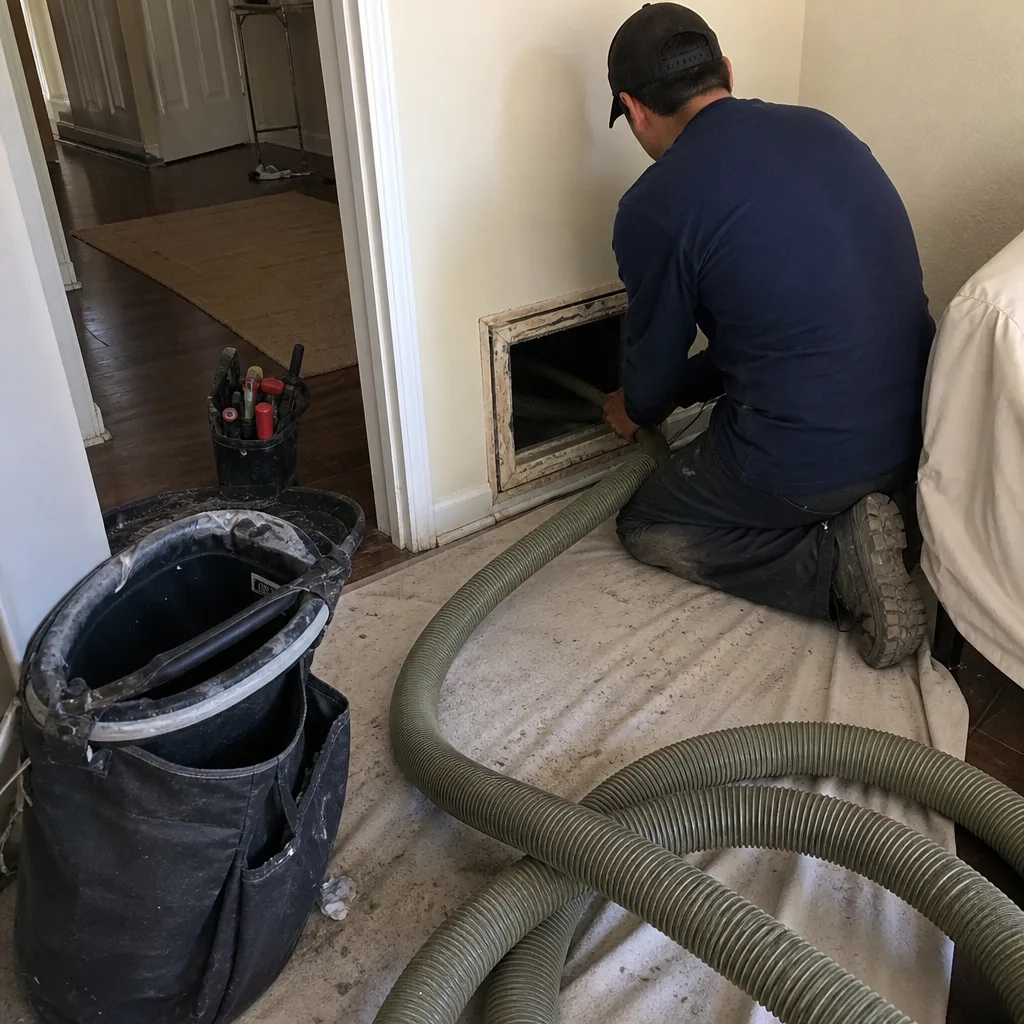
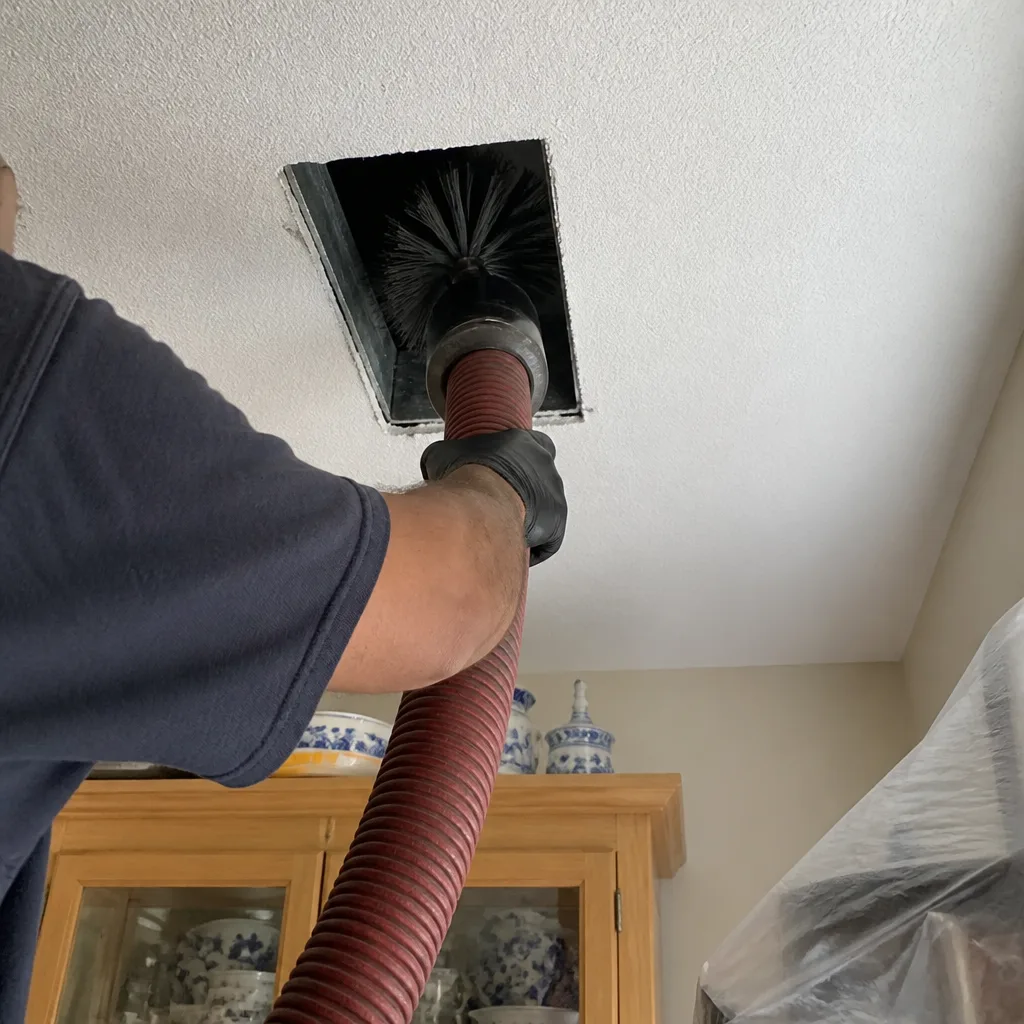
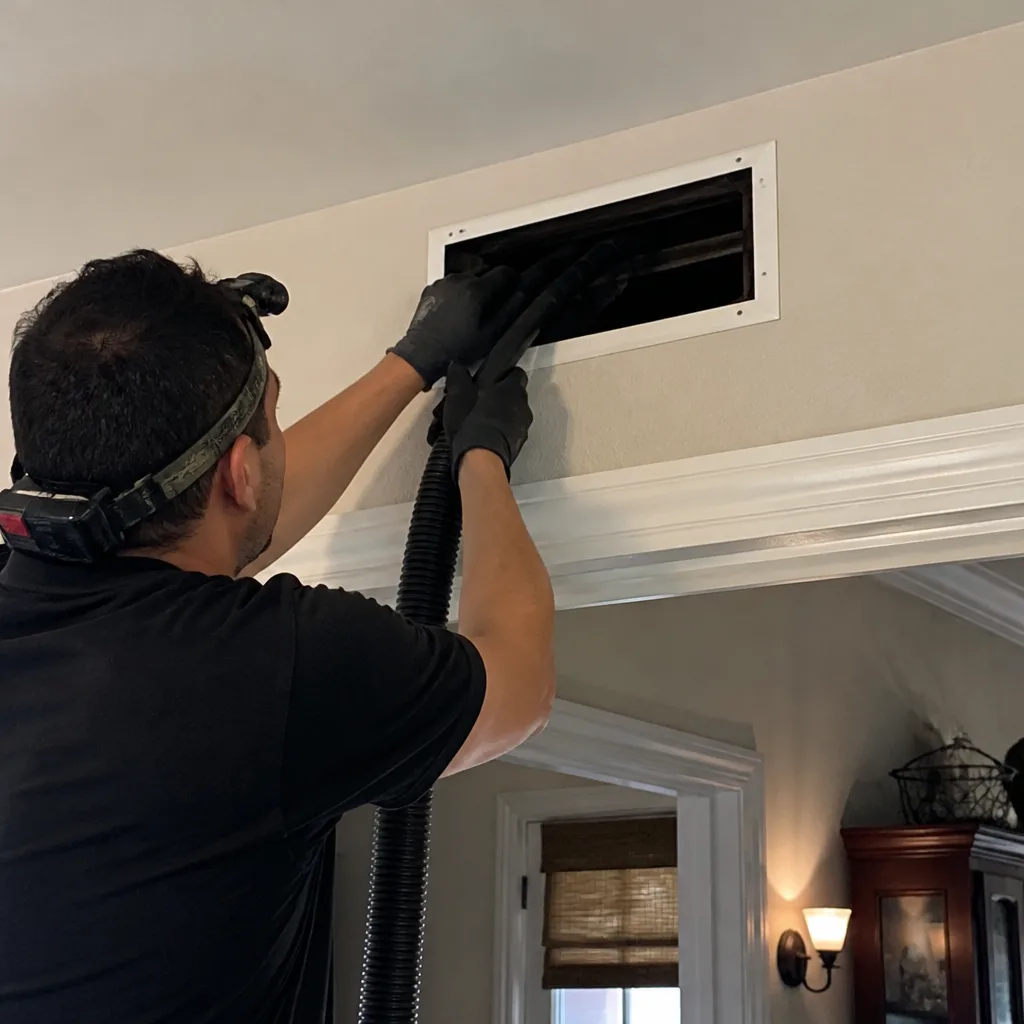
The equipment we use for Air Duct Cleaning in Oak Park includes professional Rotobrush rotary-brush systems paired with Nikro negative-pressure collection. A brush-and-vacuum combination like this physically agitates the duct wall while the vacuum captures dislodged material at the source, which is a meaningful difference from running a shop-vac hose into a register and calling it done. Your air ducts are only as clean as the equipment cleaning them.
Spring HVAC Startup: What to Inspect Before First AC Use
In Oak Park, the first sustained warm spell usually arrives in April or early May. That’s the point when air conditioners get turned on for the first time in six to eight months. Before you do that, there are specific inspection points worth addressing, because the transition from heat to cool exposes problems that don’t show up during furnace season.
Here’s what we recommend checking before your first cooling cycle of the year:
- Inspect the evaporator coil for visible debris or microbial film. The coil has been idle and possibly damp during spring temperature swings. If it looks dirty, it will reduce cooling efficiency and push air through contamination.
- Check the condensate drain line. Spring in Oak Park brings enough temperature swing to create condensation cycling. A clogged drain line will back up into the pan, which feeds microbial growth that then gets distributed through the supply ducts.
- Replace the filter regardless of how recently it was changed. Even if you changed it in March, run a fresh filter for the first month of AC use. The first cooling cycle draws in accumulated attic heat and whatever has been sitting in the return plenum since winter.
- Listen to the system during the first cycle. A clicking, rattling, or whistling sound on startup often indicates loose duct connections, debris in the blower wheel, or a failing blower motor bearing. These issues typically surface during the first heat-to-cool transition.
- Run the fan only for 30 minutes before engaging the compressor. This pushes accumulated dust through the filter without adding the moisture that cooling introduces. It’s a small step that reduces the dust bloom from the first AC day.
If you find debris, visible dust inside registers, or signs of water damage around the air handler, it’s worth having a technician assess the system before cooling season starts. Oak Park homes built in the 1980s through early 2000s often have original ductwork in attic spaces, and spring is when attic-sealed duct failures become most visible because cooling reveals condensation where the air leaks.
This is also the time to schedule Air Duct Repair in Oak Park if inspection turns up disconnected sections, crushed flex duct, or holes in the return plenum. We don’t just clean ducts, we repair what’s actually broken in the system. A cleaning cannot fix a 20-square-inch hole in a return duct, and running AC through a damaged system means you’re paying to condition the attic.
Summer: Irrigation Humidity and the Microbial Question
Summer in Oak Park is hot and dry on the surface, but underneath that exterior aridity is a hidden humidity source: landscape irrigation. Homes with automatic sprinkler systems, especially those with spray heads near foundation vents, create localized humidity that finds its way into crawlspaces and basement-level equipment. Add the condensation that occurs when cooled air moves through ducts in a 120-degree attic, and you have the conditions that support microbial activity in duct lining.
The homeowners most affected by this are those with:
- Automated sprinkler systems running multiple times per week between May and September
- Pool or spa equipment that adds ambient moisture to the immediate yard environment
- Mature oak canopy that shades the roof and attic, slowing evaporation of any moisture that enters
If you smell a musty or “damp towel” odor when the AC first kicks on during a hot spell, that is typically the signal that moisture has been accumulating inside the duct system. This is not something to ignore or mask with air fresheners. The smell indicates active microbial presence, and while we are not a mold remediation company, professional duct cleaning with agitation and negative-pressure collection removes the organic material that microbial growth feeds on. For many Oak Park homes, a late-summer cleaning after irrigation season has exposed the issue is the right call.
In cases where humidity is a recurring problem, we talk with homeowners about whole-home IAQ products from Honeywell and Aprilaire. These are brands we work with regularly, and while we don’t sell or install them, understanding how they integrate with a duct system means we can point you in the right direction for dehumidification or ventilation that addresses the root cause rather than treating symptoms.
Low-Season Maintenance: What You Can Do Yourself
Between professional cleanings, there are maintenance actions you can take that measurably extend the interval between services and improve system performance during the months when contamination inputs are low. These are practical, low-cost, and don’t require specialized equipment.
Monthly filter checks (and replacement as needed)
In Oak Park, filter replacement intervals vary dramatically by season. During Santa Ana season, a filter may load in two weeks. During January and February, it might go two months without visible discoloration. The only way to know is to look. We recommend a visual check every 30 days, year-round. If the filter face shows visible gray or tan discoloration, replace it regardless of the “90-day” claim on the package.
Register and grille cleaning
Supply registers and return grilles are the visible interface between your duct system and your living space. When dust accumulates on the register fins, that’s a signal that excess particulate is moving through the system. Clean registers with a damp cloth every two to three months. For ceiling-mounted returns, remove the grille and vacuum inside the boot opening, being careful not to reach into sharp duct edges.
UV lamp status checks (if installed)
If you have an in-duct UV lamp, check its status indicator monthly during cooling season. These lamps lose intensity over time, typically degrading below effective output after 12 to 18 months of continuous use. A lamp that’s still illuminated is not necessarily still effective. If you don’t know the installation date of your UV lamp, find out before cooling season.
Blower compartment inspection
Once per season, turn off power to the air handler and take a look at the blower compartment. Visible dust accumulation on blower blades or the housing indicates that the filter has been bypassing or underperforming. If you see significant buildup, schedule a professional cleaning before the next heating or cooling season. Do not attempt to clean the blower wheel yourself with compressed air or a vacuum; dislodging debris into the motor housing is a fast way to damage bearings.
These actions are not substitutes for professional cleaning. What they do is reduce the rate of contamination accumulation and give you early warning when something is going wrong. That early warning is what lets you schedule service in the right seasonal window rather than reacting to a system failure.
Wildfire Smoke and Your Duct System: A Specific Protocol
Wildfire smoke is the most destructive contaminant for Oak Park duct systems, and the standard homeowner response, which is to do nothing and hope it passes, leaves residue in the system for months or years. Here is a specific protocol for what to do during and after a heavy smoke event.
During an active smoke event:
- Set your thermostat fan to ON, not AUTO. Continuous circulation filters more air than intermittent operation, provided your filter is clean. If the filter is loaded, continuous operation pulls smoke through a loaded filter and redistributes captured particles.
- If you have a HEPA-capable portable air cleaner, run it in the main living area. This reduces the smoke load entering the return-air system from living spaces.
- Keep windows and doors closed as much as practical. This seems obvious, but every door opening during an active smoke event introduces a slug of smoke-laden air into the home.
- Do not run exhaust fans (bathroom, kitchen) continuously. They create negative pressure that pulls outdoor air, including smoke, into the home through any available opening.
After the smoke has cleared:
- Replace the furnace filter immediately. Even if it looks clean, it may be loaded with sub-micron particles that are not visible. This is the cheapest and most effective action you can take.
- Wipe down all supply registers and return grilles with a damp cloth. This removes surface ash before it gets pulled into the system on the next cycle.
- Inspect the area around the air handler and furnace for visible ash or soot. If you see it, do not run the system until a technician has inspected it.
- Schedule professional duct cleaning. If the smoke event was severe, with visible ash accumulation outdoors, your ducts have collected material that standard filtration will not remove. The post-Santa Ana window is already the right time for professional service in Oak Park; a heavy smoke event makes it more urgent.
Our cleaning process is built for this exact scenario. The Nikro negative-pressure system means that when we agitate and dislodge smoke particulate from duct walls, it is captured at the point of collection rather than pushed into your living space. Combined with Abatement Technologies containment and air-scrubbing equipment during service, the process is designed for homes that have been through genuine contamination events. This is not a routine vacuum-and-leave operation.
What to Look for in a Professional Duct Cleaning Service
Not all duct cleaning operations are created equal, and in Oak Park, you’ll find everything from national franchise operations to one-person operations running equipment purchased at a home center. Here’s what separates the service you want from the service you’ll regret hiring.
Equipment matters more than price. The industry standard for professional duct cleaning is a rotary-brush agitation system paired with negative-pressure collection. We operate Rotobrush rotary-brush cleaning systems and Nikro-powered suction systems for exactly this reason. The brush physically dislodges material from the duct wall; the vacuum captures it before it can enter your living space. A service that uses a vacuum hose only, without agitation, is leaving the majority of the film on the duct walls. A service that uses only compressed air is blowing material deeper into the system, not removing it.
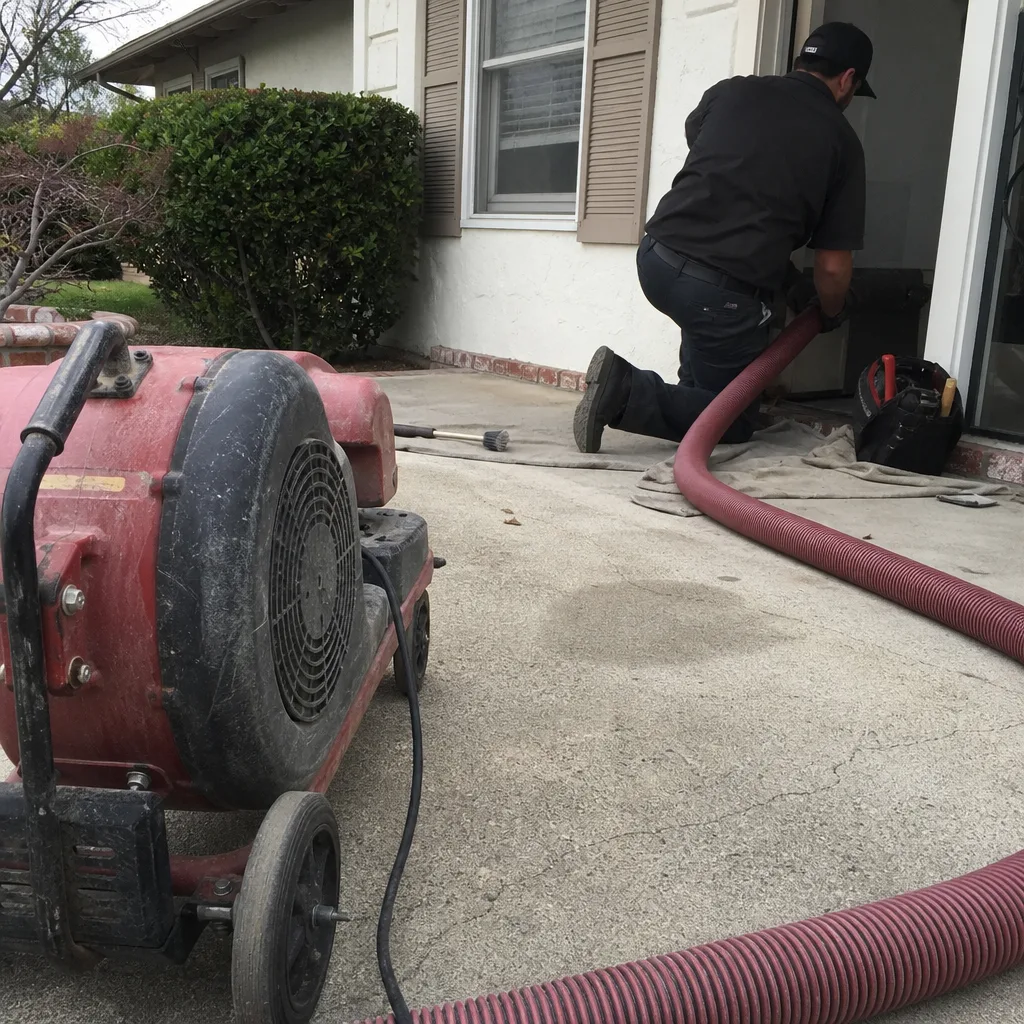
Containment is a differentiator. A professional service will use HEPA-filtered air scrubbing and containment during the cleaning process. We use Abatement Technologies air-scrubbing and containment equipment on every job. This equipment captures airborne particulate released during agitation, preventing a dust bloom in your living space. If a company shows up with a portable vacuum and no containment equipment, you are not getting professional-grade service.
Repair capability signals seriousness. A cleaning technician who is not qualified to repair ducts can only clean around problems. Disconnected sections, crushed flex, and rusted-through returns are common in older Oak Park homes, and a real specialist identifies and addresses these during the service. That’s why we offer Air Duct Repair in Oak Park as a standalone service. Problems are fixed, not cleaned around.
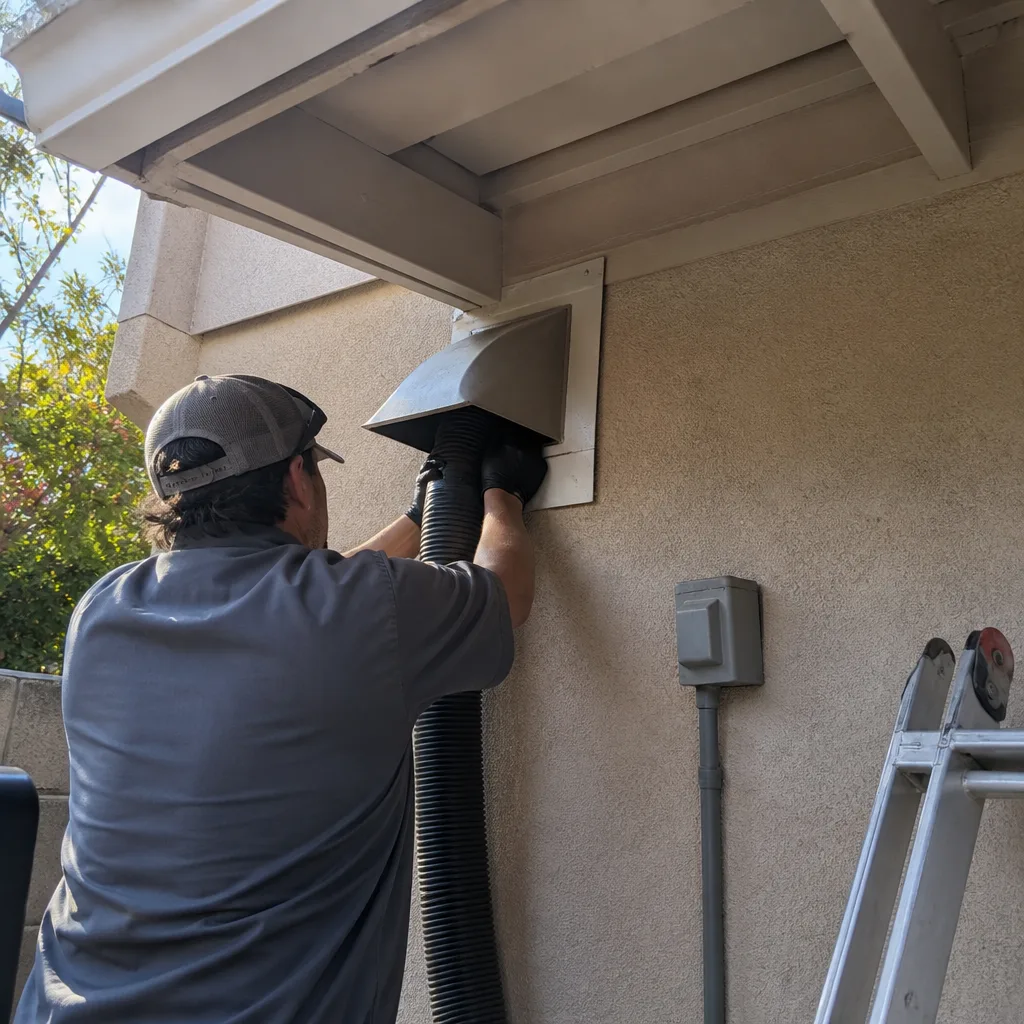
Dryer vent service should be on the menu. Dryer vent cleaning isn’t optional for Oak Park homeowners; it’s a fire-safety service. Lint accumulation is one of the leading causes of residential house fires, and Oak Park’s dry climate produces more static-prone lint conditions than coastal communities. A duct cleaning company that also maintains Dryer Vent Cleaning in Oak Park demonstrates that it understands the full range of airflow systems in the home, not just the HVAC component.
Common Mistakes to Avoid
- Cleaning too early in Santa Ana season. Scheduling duct cleaning in October, during peak wind and smoke season, means you’re cleaning a system that’s still accumulating contamination. Wait until the wind events have passed, typically November or December.
- Assuming visible filter dirt means the ducts are clean. The filter only captures what passes through it. Fine particles that bypass the filter settle in the ducts. A dirty filter means the ducts have seen more particulate than the filter could handle, not less.
- Skipping spring inspection because the AC “sounds fine.” Duct leaks and coil contamination don’t always make noise. The first high electricity bill of the summer is often the first sign that the system has been running inefficiently for weeks.
- Treating mildew smell with air fresheners. Musty odor from the vents indicates moisture in the duct system. Masking it leaves the organic material in place, feeding whatever is growing there. Address the source.
- Using the cheapest coupon service. In duct cleaning, you get what the equipment can do. A low-bid operator with a portable vacuum cannot agitate and remove the film on duct walls. The cheap service leaves the contamination in place and charges you for the privilege.
- Forgetting the dryer vent. The dryer vent is part of your home’s airflow system. A clogged dryer vent is a fire hazard, and it makes your dryer run longer and hotter. Cleaning the HVAC ducts while ignoring the dryer vent is half a job.
- Waiting for a problem before calling. The whole point of seasonal maintenance is that you schedule service before contamination becomes a health or performance issue. If your signal is visible dust on furniture, respiratory symptoms, or a spike in your energy bill, you’re already in reactive mode.
When to Call a Professional
You should call a professional duct cleaning service if any of these apply: your home is within a mile of open brush, you experienced visible ash on outdoor surfaces after wildfire season, your furnace filter is loading visibly within 30 days, you smell musty odor from supply vents when the system runs, you have not had your ducts professionally cleaned in three or more years, you’ve recently completed a remodeling project, or a family member has developed unexplained allergy or respiratory symptoms that improve when away from home. Duct Cleaning Oak Park offers free estimates in Oak Park. Call (844) 620-0479 to schedule an inspection. We’ll tell you honestly whether your system needs service and what it will take to get it right.
Frequently Asked Questions
Most Oak Park homes should have professional duct cleaning every 2 to 3 years, with the interval shortened to 12 to 18 months for homes near open brush areas, households with pets that shed heavily, homes with smokers, or residences with occupants managing allergies or asthma. Homes that experienced significant wildfire smoke exposure should be cleaned after the fire season ends, regardless of when the last cleaning occurred.
The highest-value cleaning window in Oak Park is late November through December, after Santa Ana wind season has concluded and before heavy winter furnace use begins. A secondary window is April through early May, before cooling season starts and after the temperature swings that create condensation in duct systems. Mid-summer cleanings are appropriate for homes experiencing irrigation-related humidity issues.
Yes. Wildfire smoke particles are typically 0.4 to 0.7 microns in size, far smaller than what standard 1-inch furnace filters capture (5 to 10 microns). These particles enter the return-air system during active smoke events and settle inside the ductwork, on the blower assembly, and on the evaporator coil. Professional cleaning with agitation and negative-pressure collection removes this material; standard filtration does not.
Visible dust accumulating rapidly on furniture after cleaning, visible dust or dark staining around supply registers, musty odor when the system runs, a filter loading visibly within 30 days, or unexplained respiratory symptoms in household members are all indicators that professional duct cleaning is warranted. The gold standard is visual inspection: if you remove a register and see visible dust film on the duct wall, the system needs service.
The price difference comes down to equipment and process. Operators using portable shop-vac systems with no agitation, no containment, and no professional training can offer very low prices because their operating cost is minimal. What they cannot do is physically dislodge the film of particulate from duct walls or capture it before it enters your living space. The professional Rotobrush and Nikro systems we operate cost more because they are purpose-built for the work. Your air ducts are only as clean as the equipment cleaning them.
Dryer vent cleaning is a fire-safety service, not an upsell. Lint accumulation in the dryer vent is one of the leading causes of residential house fires in the United States. In Oak Park’s dry climate, lint becomes more combustible and static build-up increases. If your dryer takes longer than 45 minutes to dry a standard load, your vent may already be partially obstructed. Call (844) 620-0479 to have your dryer vent cleaning assessed.
The Bottom Line
Oak Park homeowners can’t rely on the generic “spring and fall” duct cleaning advice that works for other climates. Our wind-driven contamination season runs September through November, which means the professional cleaning window starts after Santa Ana events end, not before they begin. Spring inspection and occasional summer cleaning round out a schedule that responds to actual conditions rather than calendar dates. The equipment used matters as much as the timing: professional-grade systems like Rotobrush, Nikro, and Abatement Technologies equipment remove what standard tools leave behind. If you’re overdue for a professional assessment, call Duct Cleaning Oak Park at (844) 620-0479. An honest evaluation costs you nothing, and knowing what’s actually in your duct system is worth more than guessing.
Written by the team at Duct Cleaning Oak Park, serving Oak Park since 2017.
See the difference
 Before
 After
 Before
 After
 Before
 After